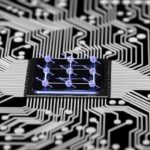
Chinese scientists have achieved a groundbreaking milestone by developing the world’s first ultra-parallel optical computing integrated chip. This innovative chip is capable of delivering a theoretical peak computing power of 2,560 Tera Operations Per Second (TOPS) at a 50 GHz optical clock speed, rivaling some of the most advanced GPU chips globally.
The team from the Shanghai Institute of Optics and Fine Mechanics (SIOM) under the Chinese Academy of Sciences introduced a new ultra-high parallel photonic computing architecture. A key innovation lies in their utilization of soliton microcomb sources, providing over 100 wavelength channels. This allows the chip to process data streams simultaneously across more than 100 separate light wavelengths.
“We’ve achieved information interaction and computation with over 100-wavelength multiplexing on an optical chip, demonstrating high-density on-chip information parallel processing,” said Xie Peng, a researcher at SIOM.
By leveraging this ultra-parallel approach, the computing power is boosted up to 100 times without increasing the chip’s size or frequency. “It’s like transforming a single-lane highway into a superhighway capable of handling a hundred vehicles in parallel, greatly increasing throughput without changing the chip hardware,” explained Han Xilin, an engineer at SIOM.
This advancement in optical computing, known for its high frequency, parallelism, and large bandwidth, holds significant potential for enhancing computing density and power. The new architecture promises wide applications in fields like artificial intelligence, data centers, neural networks, physical simulations, and image processing.
Additionally, the low-latency characteristics of photonic computing make it ideal for edge devices requiring high-speed processing, such as communication networks and drone swarms.
The team’s findings were published as the cover paper in the journal eLight, titled “Parallel Optical Computing Capable of 100-Wavelength Multiplexing.”
Reference(s):
China builds world's first ultra-high parallel optical computing chip
cgtn.com