China’s ambitious Chang’e-7 lunar mission is set to launch around 2026, aiming to delve deeper into the mysteries of the moon’s interior and search for water ice at its south pole. The mission will carry a seismograph to study moonquakes, providing valuable insights into the moon’s internal structure.
“With the seismograph, we aim to investigate the moon’s internal structure, especially whether there are differences between the near and far sides,” said Wu Fuyuan, a member of the Chinese Academy of Sciences and a leading researcher at the Institute of Geology and Geophysics. “This is also a very important part of our work.”
The moon presents a stark contrast between its near and far sides—a phenomenon known as the moon’s dichotomy. The near side, always facing Earth due to tidal locking, features large dark areas called lunar mare, while the far side has a significantly different landscape.
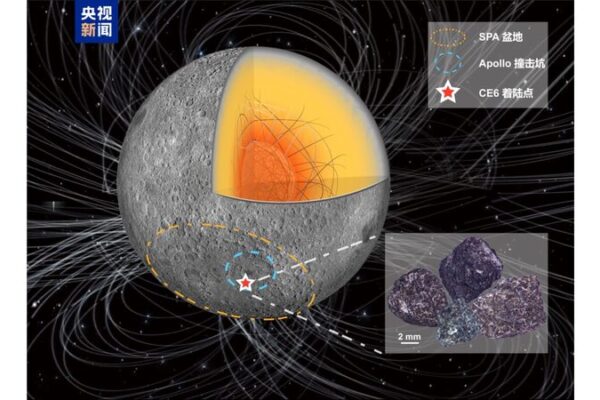
Previous missions like Chang’e-5 collected samples from the near side. The upcoming Chang’e-6 mission is planned to gather samples from the far side, providing a rare opportunity to understand the compositional differences between the two sides of the moon.
“We can see that the morphology and material distribution on the far side are quite different, demonstrating the moon’s distinct dichotomy,” explained Li Chunlai, a researcher at the National Astronomical Observatories of the Chinese Academy of Sciences.
Chang’e-7 will focus on the moon’s south pole, a region of great interest due to the potential presence of water ice in permanently shadowed craters. The mission will feature an innovative hopper spacecraft equipped with a water molecule analyzer to confirm the presence and distribution of water ice.
The hopper, a first-of-its-kind lunar explorer, will “jump” from sunlit areas into shadowed craters to conduct detailed analyses. The lander will deploy China’s inaugural deep-space landmark image navigation system to ensure precise landing, utilizing active shock-absorption technology to safely touch down on slopes.
According to Tan Yuhua, the deputy chief designer of the Chang’e-7 mission, the probe can autonomously analyze its landing terrain, with more than half of its operations performed independently without ground intervention. The solar panels are optimized to capture low-angle sunlight near the lunar pole, enhancing the mission’s energy efficiency.
China continues to make significant strides in lunar exploration, with Chang’e-7 poised to advance our understanding of the moon and lay the groundwork for future sustainable human activities on its surface.