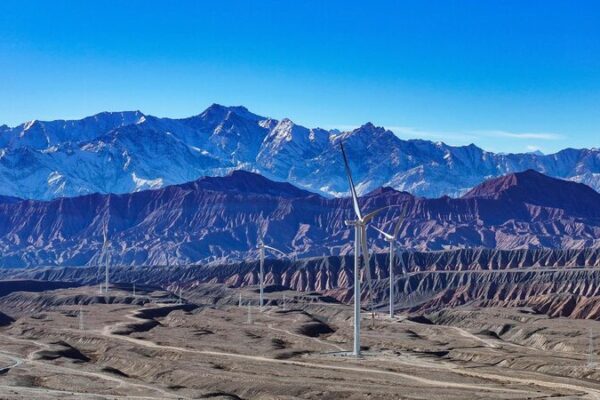
In a lightning-fast 0.007 seconds, renewable energy generated in China’s wind and solar powerhouse, the Xinjiang Uygur Autonomous Region, now lights up the bustling metropolis of Chongqing, 2,260 kilometers away. The State Grid Corporation of China announced on Tuesday the operation of the ±800 kV ultra-high voltage (UHV) direct current transmission project linking Xinjiang’s Hami to southwest China’s Chongqing.
This monumental project marks the third major endeavor to transmit electricity from energy-rich Xinjiang to other parts of the country. Xinjiang, endowed with vast deserts and abundant sunshine and wind, has transformed these once challenging landscapes into a renewable energy goldmine.
The new transmission line is expected to deliver over 36 billion kilowatt-hours of electricity annually to Chongqing’s power-hungry center, with more than half sourced from new energy. This green energy supply is equivalent to saving approximately 6 million tonnes of coal and reducing about 16 million tonnes of carbon dioxide emissions each year.
For Chongqing, a municipality with around 32 million residents and a primary energy deficit, this project is a significant boost. It’s the only provincial-level region in western China that imports more energy than it produces. The UHV line not only meets Chongqing’s growing energy needs but also supports China’s west-to-east power transmission program, balancing the energy distribution across regions.
These UHV projects are key to addressing the mismatch between Xinjiang’s massive power generation capacity and the energy demands of eastern regions. Since 2010, Xinjiang has transmitted over 900 billion kilowatt-hours of power outside the region, with renewable energy making up about 30 percent of that total. The electricity reaches 22 provincial-level regions across China.
The project exemplifies Xinjiang’s role as a national energy strategic supply base. It contributes to economic development, enhances regional cooperation, supports rural revitalization, and improves public welfare. Moreover, it plays a critical role in China’s commitment to peak carbon emissions by 2030 and achieve carbon neutrality by 2060. In 2024, 86 percent of China’s newly installed power capacity came from renewable sources, signaling a significant shift towards sustainable energy.