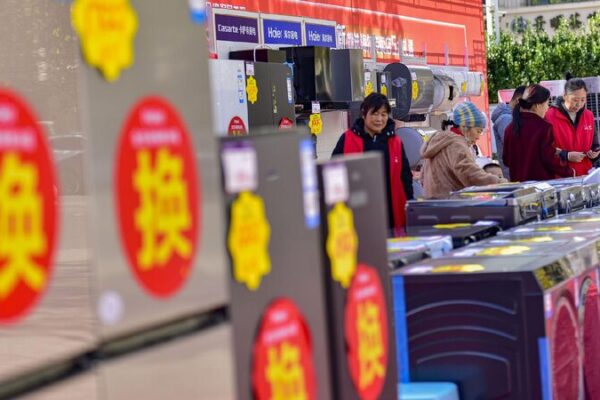
China has announced it will continue funding its consumer goods trade-in program, aiming to boost domestic consumption by encouraging people to swap old products for newer, more efficient models.
The program, a significant part of China’s strategy to stimulate the economy, offers subsidies to consumers who trade in outdated items like home appliances, smartphones, and vehicles. The central government has allocated a substantial 300 billion yuan ($41.84 billion) in treasury bonds to support the initiative through 2025, doubling last year’s funding.
“Currently, about half of the annual subsidy budget has been utilized, a pace well within expectations,” said an official with the National Development and Reform Commission (NDRC).
The increased funding has already had a noticeable impact. Sales of various products, from smartphones to electric bicycles, have surged. According to the Ministry of Commerce, sales driven by the trade-in policy this year have surpassed the total recorded in the whole of last year.
As of May 31, the program has boosted sales of five key categories of consumer goods totaling 1.1 trillion yuan this year, with about 175 million subsidy payments issued directly to consumers.
Local authorities are also playing a crucial role by providing matching funds and implementing supplementary measures. Cities like Beijing are expanding subsidy coverage to include smart and elderly-friendly home appliances, offering subsidies covering up to 15 percent of the final sale price.
“The trade-in policy contributes over half of our daily sales. Many of our new products qualify for subsidies, which greatly appeals to customers,” said Wu Zhirong, manager of an Oppo smartphone store in Beijing.
Experts believe that the program not only boosts immediate sales but also promotes product upgrades and industrial transformation. “With continued institutional improvements and increased funding, the policy is set to deliver wider benefits and reach more consumers,” said Yao Dongmin, a professor at the Central University of Finance and Economics.
Looking ahead, China plans to ensure the program is carried out smoothly and may expand it to include more products, such as sporting goods, to meet diverse consumer demands and stimulate growth in wider industries.
The initiative also encourages sustainable consumption by offering higher subsidies for green, energy-efficient products. Wang Hao, a professor at Peking University, expects Chinese manufacturers to be incentivized to innovate and transition toward greener technologies.
“As long as we focus on the most promising areas of consumption and ensure the effective implementation of trade-in policies, we can further unlock consumer potential and support China’s long-term economic development,” said Huang Zhengxue, a researcher at a think tank affiliated with the NDRC.