One year after its grand opening, the Shenzhen-Zhongshan Link has not only revolutionized transportation in China’s Guangdong-Hong Kong-Macao Greater Bay Area (GBA) but also ignited economic growth and regional integration. This groundbreaking 24-kilometer cross-sea project connects Shenzhen and Zhongshan, slashing travel time from two hours to just 30 minutes.
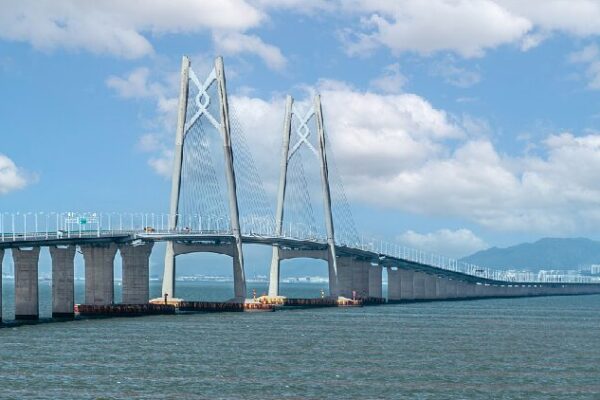
The link features two bridges, two artificial islands, and a two-way eight-lane tunnel with underwater channels. Starting at the Shenzhen airport interchange, it stretches across the Pearl River to Ma’anshan Island in Zhongshan. Over the past year, more than 31 million vehicles have traversed the link, with daily traffic records broken multiple times. On May 1, a staggering 181,600 vehicles crossed in a single day.
“The opening of the Shenzhen-Zhongshan Link has accelerated integration,” said Liao Lei, manager of a local electronic equipment company in Shenzhen. “We moved our manufacturing base to Zhongshan while keeping our headquarters in Shenzhen. We are very confident about the future.”
The enhanced connectivity has prompted over 168 companies to relocate from Shenzhen to Zhongshan in 2024, more than tripling the previous year’s growth. Zhongshan is capitalizing on this momentum by consolidating over 48,000 acres of industrial land, offering enterprises expansive and cost-effective manufacturing bases.
This year, Zhongshan is hosting a global investment promotion conference with over 400 investors and business leaders from more than 20 countries and regions, including the UK, Russia, Germany, and Singapore. “The event attracts a batch of key projects, with the intended investment amount expected to exceed 100 billion yuan (about $13.94 billion),” said Zheng Guanting, deputy director of the Zhongshan Investment Promotion Bureau.
Xu Zhijun, marketing director of a semiconductor company in Guangzhou’s Nansha District, noted that the link has greatly improved communication and coordination with Greater Bay Area customers. “The government provides a platform that enables upstream and downstream enterprises to form industrial cluster advantages,” said Xu.
To ensure safe and efficient travel, the link employs intelligent technologies like big data and artificial intelligence for optimized traffic management. An anomaly detection system monitors for unusual behavior, instantly alerting personnel to any issues. In emergencies, the system can activate over 400 devices, including automatic sprinklers, within seconds.
Undersea tunnels are inspected by intelligent robots, and a digital twin platform offers a real-time 3D model of the link, displaying vehicle trajectories and speeds. An integrated smart traffic application system guides vehicles along optimal routes, enhancing overall traffic efficiency in the link and surrounding road network.
The Shenzhen-Zhongshan Link stands as a testament to China’s commitment to innovation and regional development, fostering deeper cooperation and a brighter economic future for the Greater Bay Area.