China’s Chang’e-6 Unveils Mysteries of the Moon’s Far Side
Chinese scientists have made groundbreaking discoveries about the moon’s far side, thanks to samples collected by the Chang’e-6 mission. These findings shed new light on volcanic activity, ancient magnetic fields, water content, and the geochemical makeup of the moon’s mantle.
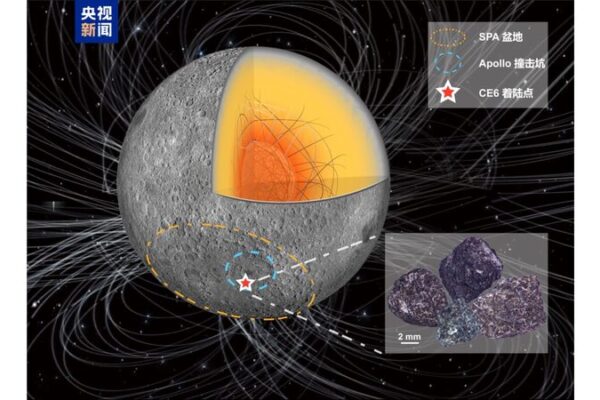
Four research teams from the Chinese Academy of Sciences (CAS) and other institutions published their studies in the latest issue of Nature. These teams analyzed samples from the South Pole-Aitken (SPA) Basin, the moon’s largest, deepest, and oldest crater, providing an unprecedented glimpse into the lunar far side’s evolution.
Unlocking the Secrets of the Moon’s Dark Side
The moon’s far side, often called the “dark side” not because it’s devoid of light but because it’s hidden from Earth, has long been a mystery. The Chang’e-6 mission made history by bringing back 1,935 grams of lunar samples from this enigmatic region.
“The SPA Basin, measuring about 2,500 kilometers in diameter, was formed by an impact with energy a trillion times greater than an atomic bomb,” said Wu Fuyuan, a leading researcher at CAS. “Our studies reveal, for the first time, the effects of this colossal impact on the moon’s evolution.”
Surprising Discoveries
Among the exciting findings, scientists discovered evidence of volcanic activity on the moon’s far side around 4.2 billion and 2.8 billion years ago. This suggests that volcanic activity persisted for at least 1.4 billion years longer than previously thought.
They also obtained new information about the moon’s ancient magnetic field, indicating a possible resurgence in magnetic intensity around 2.8 billion years ago. Additionally, they found that the water content in the lunar far-side mantle is significantly lower than that of the near side, highlighting a major difference in water distribution between the two hemispheres.
“We found that the mantle source of basalt from the SPA Basin is extremely depleted in incompatible elements,” explained Yang Wei, a researcher with the Institute of Geology and Geophysics. “This discovery shows how massive impacts can profoundly influence the moon’s deep interior evolution.”
Changing Our Understanding of Lunar History
These findings provide direct evidence of the deep interior properties of the moon’s far side, offering unique insights into how the moon’s interior layered, cooled, and evolved. This represents a crucial step toward solving the longstanding mystery of why the lunar near and far sides are so different.
“There’s lots of new findings coming from the Chang’e-6 samples that are turning many established theories in lunar science upside down,” said Mahesh Anand, a professor at the Open University in the UK. “It’s necessitating a reexamination of many of those theories.”
A Leap Forward in Space Science
Chinese scientists are enthusiastic about the potential for further discoveries. “We hope the comprehensive development of space science, technology, and applications will be further promoted,” said Guan Feng, director at the Lunar Exploration and Space Engineering Center. “We urge more scientists to use the extraterrestrial samples and data from China’s lunar and deep space missions to achieve more results.”
Previously, China’s Chang’e-5 mission analyzed samples from the moon’s near side and found evidence of volcanic activity dating back 2 billion years, extending the known timeline by 1 billion years. These achievements highlight the deep integration between science and engineering in China’s lunar exploration program.