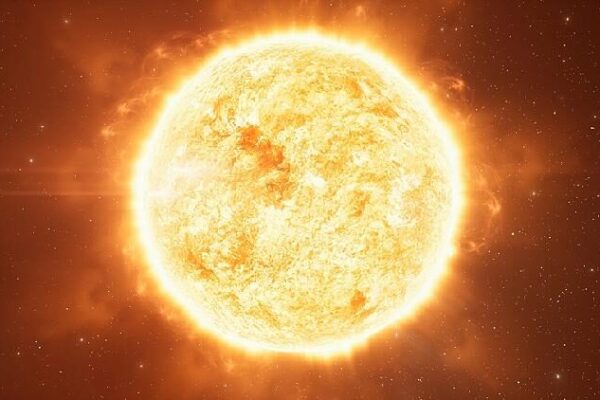
The European Space Agency (ESA) has unveiled the first artificial solar eclipses created by a pair of satellites flying in precise formation. This groundbreaking achievement provides scientists with unprecedented hours of on-demand totality to study the sun’s outer atmosphere.
Released at the Paris Air Show on Monday, the images showcase the success of the Proba-3 mission—a $210 million project launched late last year. Since March, these two cube-shaped satellites have been simulating solar eclipses while orbiting tens of thousands of kilometers above Earth.
Flying just 150 meters apart, one satellite blocks the sun, mimicking the moon during a natural eclipse, while the other focuses its telescope on the sun’s corona—the luminous outer layer that forms a striking halo of light. This intricate maneuver requires extreme precision, with the satellites maintaining a separation accuracy within a millimeter—the thickness of a fingernail.
“It’s like a carefully choreographed dance in space,” said Andrei Zhukov, lead scientist at the Royal Observatory of Belgium. “We’re aiming for up to six hours of totality per eclipse when scientific observations begin in July.”
So far, Proba-3 has generated 10 successful artificial eclipses during its checkout phase, with the longest lasting five hours. Over the two-year mission, Zhukov anticipates an average of two eclipses per week, totaling nearly 200 eclipses and more than 1,000 hours of totality.
This marks a significant leap for solar research, as natural total solar eclipses provide only a few minutes of totality every 18 months on average. “Having continuous access to the sun’s corona will be a game-changer for understanding solar dynamics,” Zhukov added.
What sets this mission apart is the use of two separate satellites for the sun-blocking disk and the corona-observing telescope. Previous missions, like ESA and NASA’s Solar Orbiter and SOHO observatory, housed both instruments on a single spacecraft. The distance between Proba-3’s satellites allows scientists a clearer view of the corona closest to the sun’s edge.
The success of Proba-3 could pave the way for future space missions utilizing formation-flying satellites to unlock more cosmic secrets.