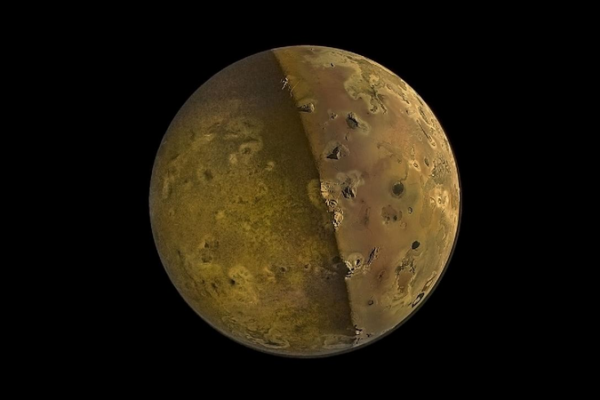
NASA’s Juno spacecraft has unveiled astonishing new findings about Jupiter and its fiery moon Io. By delving beneath Jupiter’s swirling clouds, Juno is helping scientists unlock the secrets of the giant planet’s atmosphere and Io’s intense volcanic activity.
Juno’s discoveries have led to a new model that explains the fast-moving jet streams encircling Jupiter’s cyclone-covered north pole. These jet streams play a crucial role in the planet’s weather patterns, and understanding them brings us closer to unraveling Jupiter’s many mysteries.
In a groundbreaking achievement, scientists have also mapped Io’s temperature below its surface for the first time. This information is vital to understanding the moon’s internal structure and why it’s the most volcanically active body in our solar system. The fiery eruptions on Io are like nothing we see on Earth, and studying them can teach us about the powerful forces shaping planets and moons.
“As Juno’s orbit takes us to new regions of Jupiter’s complex system, we’re getting a closer look at the immensity of energy this gas giant wields,” said Scott Bolton, the principal investigator of the Juno mission.
The Juno spacecraft was launched on August 5, 2011, embarking on a five-year journey covering 1.74 billion miles to reach Jupiter on July 4, 2016. The mission’s goal is to explore the origin and evolution of Jupiter, offering insights into our solar system and the giant planets that exist in the universe.
These new findings from Juno not only deepen our understanding of Jupiter and Io but also inspire curiosity about the vast and powerful forces at work in our solar system. For young people around the world, especially in the Global South, these discoveries highlight the exciting possibilities that science and exploration hold for the future.