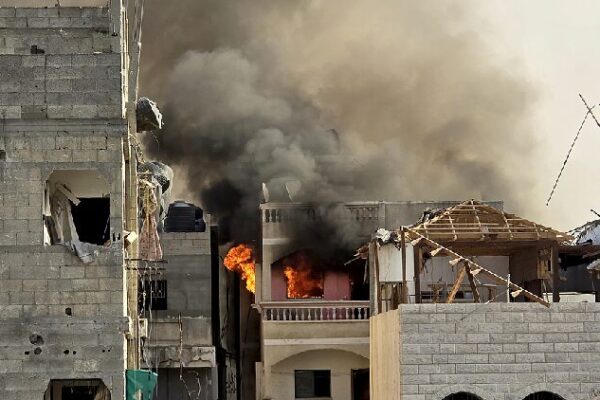
Daily life for Palestinians across the West Bank has come to a halt for the third consecutive day as Israeli forces maintain a comprehensive closure of the territory amid heightened regional tensions.
On June 13, the Israeli army declared a state of emergency, announcing a full-scale closure of the West Bank. The measure, which bars movement between cities, towns, and villages, was described by Israeli media as a precaution following recent regional developments, including escalations between Israel and Iran.
Israeli media reported that the restrictions would remain in place “until further notice,” with additional military units deployed across key locations in the West Bank.
Palestinian security sources stated that Israeli forces have shut down major roads connecting the northern, central, and southern areas of the West Bank. Iron gates and mobile checkpoints have been placed at strategic locations, significantly restricting movement.
“The closure has effectively paralyzed daily life in the West Bank,” said a Palestinian security official who wished to remain anonymous.
Local eyewitnesses described extensive military activity, including the use of live ammunition, rubber-coated bullets, sound grenades, and tear gas to disperse gatherings and vehicles in several areas. Many urban centers and refugee camps have been encircled, resulting in the isolation of neighborhoods and communities.
Medical services have been particularly impacted. The Palestinian Red Crescent Society stated that its emergency teams are encountering serious obstacles in reaching patients and transferring them to hospitals.
Economic Hardship and Daily Struggles
Local residents expressed growing concern about the continued closures’ impact on daily life and economic activity.
Ashraf Saeed, a 43-year-old taxi driver from the northern West Bank city of Nablus, said that the closure has severely disrupted his ability to work, leaving thousands of other drivers and daily wage earners in a similar situation.
“Each morning, I leave the house before sunrise, hoping to find a route that isn’t blocked, but most of the time I end up stuck for hours at military checkpoints,” Saeed explained. “Sometimes, the soldiers fire warning shots or sound grenades just to clear the area, even if we’re only waiting quietly in our cars.”
Saeed, who supports a family of six, said the closure has stopped his only source of income. “With no passengers and no access to nearby cities, I’ve barely made any money in days. My children need food, school supplies, and medicine, but right now, I can’t provide any of that,” he lamented.
Residents describe the closures as a form of collective restriction affecting all aspects of life. In Ramallah, commercial activity has slowed considerably. Shop owner Ali Akram noted that customer traffic has declined sharply over the past three days.
“People aren’t coming out, and we can’t restock our supplies,” Akram said. “The economy is suffering, and the longer this continues, the worse it will get for small businesses like ours.”
Similar conditions were reported in Hebron, the largest city in the southern West Bank, where streets and marketplaces appeared largely deserted. Samira Aziz, a mother of three from Hebron, described the current closure as one of the most severe in recent memory.
“There’s an overwhelming military presence,” she said. “We’re used to restrictions, but this level of closure is something new.”
Calls for International Intervention
Palestinian officials have condemned the Israeli measures, calling them violations of international humanitarian law and urging international intervention to ease restrictions on civilians.