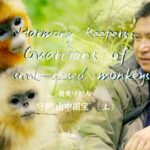
In the lush Mount Fanjing National Nature Reserve in southwest China’s Guizhou Province, a groundbreaking conservation effort is underway to save one of the world’s most endangered primates. The Guizhou snub-nosed monkey, a species found only in China, has a global population of about 850 individuals. As summer brings warmer temperatures, these elusive monkeys are more active across the 282-square-kilometer core area of the reserve, which spans elevations from 600 to 2,200 meters.
To protect these rare animals, Yinjiang County launched an ecological corridor project within the monkeys’ prime habitat. The initiative includes planting nearly 10,000 food-source plants, restoring water sources, and installing 126 infrared cameras along 18 monitoring lines across 4.3 square kilometers. This high-tech approach provides crucial data for conservationists, allowing them to monitor the monkeys and their environment in real time.
At the heart of these efforts is the Guizhou Snub-nosed Monkey Research Center in Tongren. Home to eight of these rare primates, the center has achieved a significant milestone by completing whole-genome sequencing of its captive population and establishing a genetic resource database. This scientific advancement is key to understanding the species and enhancing breeding programs.
The reserve itself boasts a state-of-the-art monitoring network with 91 video surveillance systems, over 460 infrared cameras, and 10 weather stations. A dedicated team of 140 forest rangers conducts regular patrols, often aided by drones. Since 2022, 11 experts have joined the team, contributing to the rescue of four wild Guizhou snub-nosed monkeys and more than 300 other animals, totaling 343 rescues as of June 2023.
Adding to these efforts, the Guizhou Snub-nosed Monkey Rescue Protection and Wildlife Rescue Project in Taiping Town is nearing completion. With an investment of 46 million yuan ($6.4 million), the 4,329-square-meter facility features an animal rescue center, a pathology laboratory, and an ecological restoration zone. Equipped with specialized equipment like anesthesia monitors and X-ray machines, the center aims to become China’s first standardized conservation hub when it opens later this year.
Guizhou’s multi-pronged strategy—combining infrastructure upgrades, scientific innovation, and community engagement—not only boosts the survival prospects of these unique primates but also sets a global example for endangered species protection.
Reference(s):
Multifaceted moves shield endangered Guizhou snub-nosed monkeys
cgtn.com