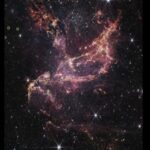
High atop a ridge 5,250 meters above sea level in the Xizang Autonomous Region of the Chinese mainland, a new telescope has opened its eyes to the universe’s earliest secrets. Scientists have announced that the AliCPT-1 telescope has captured its first clear images of the Moon and Jupiter at 150 GHz, marking the official start of China’s first search for primordial gravitational waves.
These primordial gravitational waves are faint ripples from the dawn of time, believed to be created by quantum fluctuations in spacetime during the universe’s rapid expansion known as cosmic inflation. Detecting these elusive signals could unlock mysteries about how the universe began.
“If we successfully detect primordial gravitational waves, we will glimpse the universe in its very first instant,” said Zhang Xinmin, a researcher at the Institute of High Energy Physics (IHEP) under the Chinese Academy of Sciences.
Not only could this discovery shed light on the origins of the cosmos, but it could also drive breakthroughs in advanced technologies like cryogenic superconducting detectors and low-temperature electronics, propelling cosmology into an era of unprecedented precision.
The telescope is the result of an eight-year collaboration led by the IHEP, involving a global team of 16 institutions, including China’s National Astronomical Observatories and Stanford University. Located on the “roof of the world,” the telescope’s high-altitude placement helps it avoid atmospheric water vapor that can interfere with the detection of these subtle signals.
“Only four sites on Earth are suitable for such observations: Antarctica, Chile’s Atacama Desert, the Qinghai-Xizang Plateau, and Greenland,” said Liu Congzhan, a project manager for the telescope.
Li Hong, another researcher at the IHEP, noted that the initial observations of the Moon and Jupiter are just the beginning. “As the Northern Hemisphere’s first high-altitude primordial gravitational-wave observatory, the telescope fills a gap for the Chinese mainland and, along with devices in Antarctica and Chile, completes a global network of complementary observatories,” he said.
Reference(s):
Telescope on world's roof starts hunt for Big Bang's oldest ripples
cgtn.com